
A colleague buys a saloon at a great price from a private seller. Three months later, the timing belt fails: the repair bill comes to more than half the price they paid for the car.
This scenario is all too common, and it almost always follows the same pattern: a budget based solely on the purchase price, with nothing set aside for maintenance and no thorough checks before signing. Choosing a reliable used car without exceeding your budget means getting a few key things right well before you start browsing listings.
The true cost of a used car: what the asking price doesn’t include
The listed price of a used car is only part of the total cost. Buyers often forget about registration fees, insurance (which can vary considerably depending on the model and the driver’s age), and, above all, maintenance: timing belt, brake pads, tyres and oil changes.
Setting an overall budget means adding the purchase price, administrative fees and a reserve for foreseeable mechanical work during the twelve months after purchase. A cheaper car with a neglected maintenance history will cost more than a slightly pricier model with a complete service record.
On legrand-bretagne-auto.fr, listings from dealers often include detailed maintenance histories, making it easier to assess these costs before arranging a viewing.
Calculating the total cost over a year, rather than just the purchase price, radically changes which models are worth considering. A well-maintained petrol city car with reasonable mileage will almost always be a safer bet than a diesel SUV listed at the same price but not serviced for several years.
HistoVec and the roadworthiness test: two documents that tell different stories

Many buyers assume that a recent roadworthiness test with no retest required guarantees the car is in good condition. In reality, the test covers a limited number of points and is not a full mechanical inspection. For example, it won’t detect internal engine wear or the true condition of the clutch.
HistoVec, the government’s free service, provides access to the vehicle’s administrative history: changes of ownership, reported claims and administrative status. But HistoVec does not list every repair or accident. A vehicle may have been involved in an unreported collision without any trace of it appearing in the report.
The best approach is to cross-check both documents against the maintenance invoices provided by the seller. Any period without supporting documents is worth asking about directly. If the seller can’t explain a gap of several years in the history, move on to the next car.
Have an independent expert inspect the car before buying
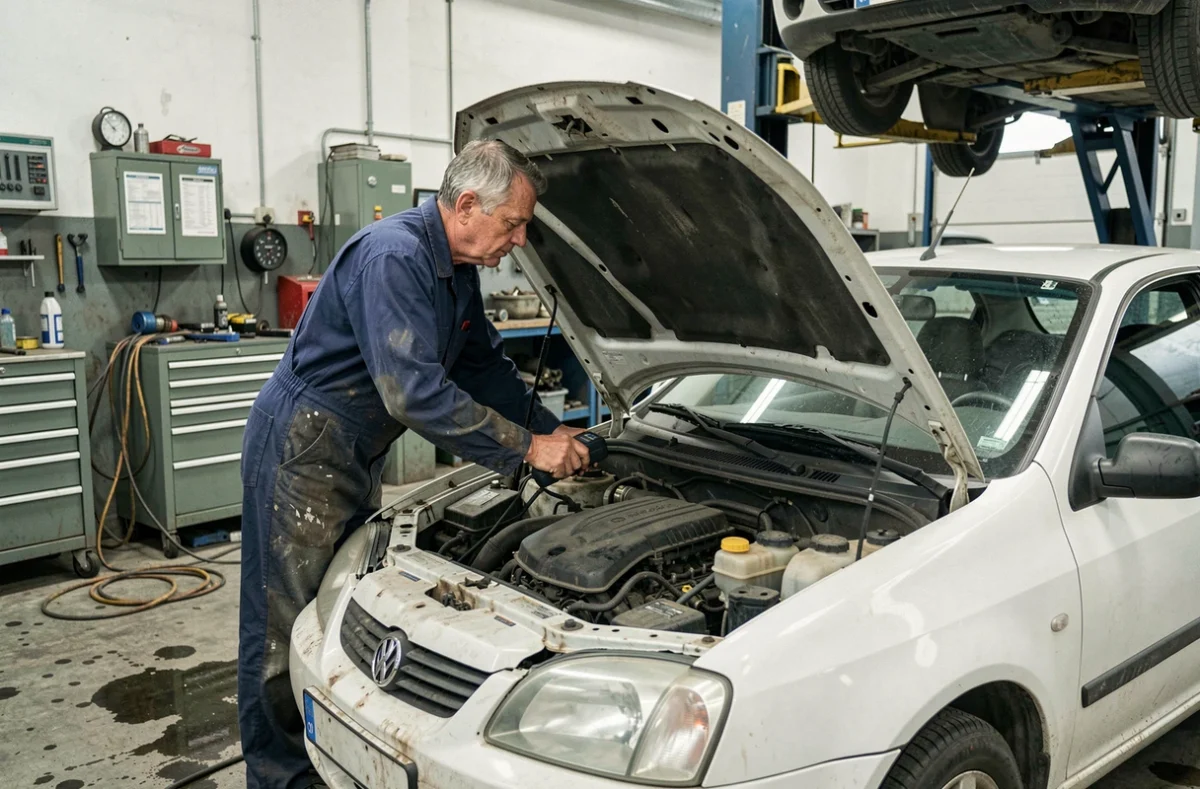
Asking an independent mechanic to carry out a pre-purchase inspection costs one to two hours of labour. It can uncover problems that won’t show up on a roadworthiness test report, such as play in the steering, an emerging leak or worn suspension bushes. This step is especially useful when buying from a private seller, since the legal guarantee of conformity does not apply: only the hidden-defects warranty may offer protection, and it is harder to claim.
Petrol, hybrid or diesel: the right choice depends on your daily commute
The usual rule of thumb is to choose diesel if you drive a lot and petrol for city use. That still holds true, but the growing number of used hybrids makes the choice more complicated.
- If most of your daily driving is in the city (less than thirty kilometres a day), consider a petrol city car or a non-plug-in hybrid, which uses considerably less fuel in town than a conventional engine alone.
- For mixed driving that regularly includes motorways, diesel can still make sense if your annual mileage is high, provided the vehicle is not affected by restrictions in your local low-emission zone (ZFE).
- A used plug-in hybrid may seem appealing, but its traction battery loses capacity over time. Without access to a daily charging point, you’ll end up driving in combustion-engine mode with the extra weight permanently increasing fuel consumption.
ZFE restrictions vary by local authority, geographical area and time of day. Check your local ZFE rules before buying to avoid ending up with a car that you’re not allowed to drive in your own city. A low-priced Crit’Air 3 diesel can lose all its value if the relevant metropolitan authority tightens its restrictions in the months ahead.
Buying from a dealer or a private seller: how the warranty affects your budget
Buying from a dealer generally costs a little more, but the legal protection is different. When you buy from a dealer, you’re covered by the legal guarantee of conformity: any fault is presumed to have existed at the time of sale during the first twelve months, unless the seller can prove otherwise. In practical terms, if a fault appears during that period, you don’t have to prove that it was already there before the sale.
When buying from a private seller, this presumption does not apply. You have to rely on the hidden-defects warranty, which requires you to prove that the defect existed before the sale, was hidden and makes the vehicle unfit for use. The burden of proof falls on the buyer, making claims more difficult and time-consuming.
When money is tight, it can be tempting to go for a lower price from a private seller. But a major breakdown that isn’t covered in the first few months can wipe out the savings. The extra cost of buying from a dealer effectively acts as built-in mechanical insurance.
Models known for reliability and affordable maintenance
Toyota Corolla, Dacia Sandero, Peugeot 208, Renault Clio: these models consistently come up in real-world reviews for their reliability and readily available, affordable spare parts. The right choice depends on the size and type of engine you’re looking for, but at the same budget, choosing a common model keeps parts costs and repair times down.
A rarer or premium model listed at the same price often comes with higher maintenance costs. A car’s market value doesn’t always reflect its true cost of ownership over two or three years.
Choosing a reliable used car without exceeding your budget is less about instinct than having a method. Calculate the total cost, cross-check the documents, get the car inspected, check that it meets ZFE requirements and choose where to buy based on how much warranty protection you can afford to go without. Choose the model last, once you’ve set the ground rules.