
A hedge trimmer cuts branches by shearing them with two interlocking toothed blades. Choosing the right model depends on three interrelated parameters: the type of hedge to maintain, the power source of the motor, and the blade geometry. Understanding these three parameters helps avoid a poorly calibrated purchase, which can lead to fatigue or uneven cutting.
Tooth spacing and cutting diameter: the often-overlooked technical criterion
Before comparing motors, one must look at the blade. The spacing between the teeth of the blade determines the maximum diameter of branches that the device can cleanly cut.
A narrow spacing is suitable for boxwood or privet hedges, where the twigs remain thin. For laurel or old thuja, where the branches become woody, a wider spacing is necessary to avoid jamming the blade or tearing the bark instead of making a clean cut.
The length of the blade plays a different role: it determines the cutting width in a single pass. A short blade offers more maneuverability for topiaries and rounded shapes. A long blade speeds up work on a straight hedge several meters long but adds weight and complicates finishing touches. The catalogs available on taille-haie-warrior.com allow for comparisons of these dimensions according to models and brands.
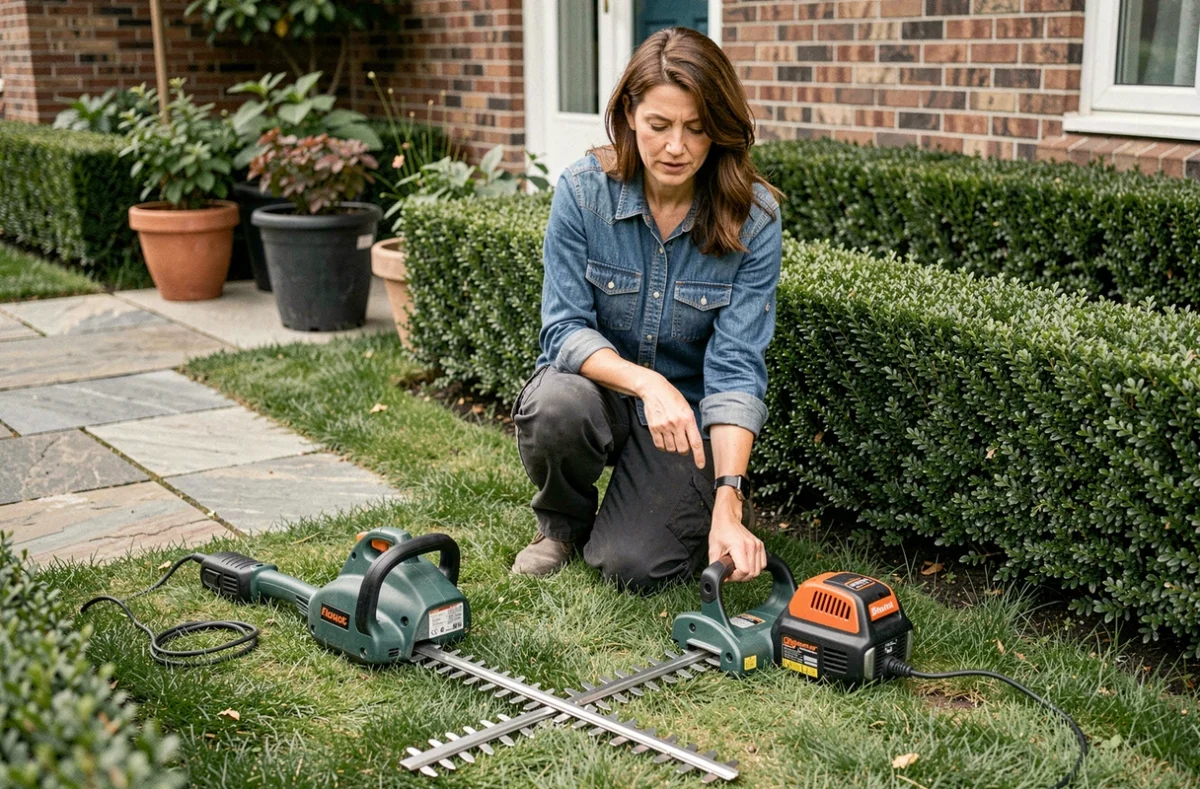
Battery, corded, or gas hedge trimmers: understanding each power source
The power source is not just a matter of convenience. It affects weight, noise level, battery life, and the type of maintenance required.
Corded electric models
Lightweight and quiet, corded hedge trimmers deliver constant power as long as they are plugged in. Their limitation is physical: the cord restricts the working radius and requires constant vigilance to avoid cutting it while working.
A corded model is suitable for hedges located close to a power outlet, over moderate lengths. Beyond that, managing an extension cord becomes a real hindrance.
Battery-operated models
Battery hedge trimmers offer freedom of movement comparable to gas models, without the noise pollution or exhaust fumes. The battery voltage (often expressed in volts) indicates the available power: the higher the voltage, the denser branches the device can cut without slowing down.
The trade-off is battery life. On a large hedge, a single charge may not be sufficient. Having a spare battery solves the problem but increases the budget.
Gas models
Gas hedge trimmers remain the most powerful. They handle old, dense, and long hedges with thick branches without difficulty. However, their weight, noise, and vibrations can tire the user during extended sessions.
Mechanical maintenance (spark plug, air filter, oil-gas mixture) adds to the cost of use, unlike electric models that only require cleaning and lubricating the blades.
Noise constraints and local regulations before purchasing a hedge trimmer
The choice of power source does not depend solely on the garden. In France, the hours of use for a hedge trimmer are set by municipal or prefectural decree, not by a single national rule. The Public Health Code (article R.1336-5) prohibits noise that disturbs the tranquility of the neighborhood due to its duration, repetition, or intensity.
In a dense housing development, a battery model allows for work during broader time slots without the risk of complaints. A gas model, being noisier, often requires adherence to restricted hours, especially on weekends. Checking the municipal decree before purchase helps avoid recurring neighborhood conflicts.
Pruning period and legal framework: a factor that weighs on the choice
The agricultural orientation law of March 24, 2025, introduced a strengthened framework for the protection and sustainable management of hedges. Departmental decrees must take into account sensitive periods for local species, with work prohibitions whose practical enforcement is announced to begin in 2027.
The French Biodiversity Office already recommends avoiding pruning from March 15 to July 31, during the bird nesting period. The actual pruning calendar thus reduces to two main windows: late winter (February to early March) and late summer (September to October).
This constraint has a direct consequence on the equipment. If the hedge can only be pruned twice a year, the regrowth between two sessions is more significant. Therefore, a device capable of cutting thicker branches than with monthly maintenance is needed, which leads to a more powerful model or wider tooth spacing.
Weight and ergonomics of the hedge trimmer: the impact on working duration
A hedge trimmer is held at arm’s length, often above the head to reach the top of the hedge. Every additional hundred grams is felt after a few minutes.
- The rotating handle (available on some models) allows switching from horizontal to vertical cutting without twisting the wrist, reducing fatigue on tall hedges.
- An anti-vibration system protects the joints during prolonged use, especially on gas models whose motors transmit more shocks.
- The hand guard (or deflector) prevents cut branches from falling back on the hands and is part of the safety features to check before purchase.
For a tall hedge that exceeds arm’s reach, a pole hedge trimmer eliminates the need for a ladder. The telescopic handle adds weight and alters the balance of the tool but removes the risk of falling from height.
The right hedge trimmer is not the most powerful or the cheapest: it is the one whose blade matches the diameter of your branches, whose power source complies with your local noise constraints, and whose weight remains manageable throughout the duration of the job. Checking the municipal decree and the departmental pruning calendar before ordering prevents leaving a new device in the garage for months.