
You receive a speeding ticket for exceeding the speed limit, but no one stopped you on the side of the road. The ticket mentions a twin radar check. No photo of the vehicle, no interaction with an officer. This scenario, increasingly common, opens up solid avenues for contestation, provided you know where to look for the flaws.
Twin radar calibration: the procedural flaw that nullifies the process
Before looking into whether the measured speed is contestable, check a technical point on the ticket itself. Since decree n°2025-347 of April 15, 2025, officers using twin radars must explicitly state on the report that the calibration of the device is less than six months old. If this mention is absent, the procedure is automatically null and void in case of contestation.
Specifically, take your speeding ticket and look for the reference to the date of the device’s metrological verification. If it is missing, or if the date indicated exceeds six months at the time of the check, you have a strong procedural argument. This type of procedural flaw has led to a significant increase in the annulment of twin tickets since the decree came into effect.
To delve deeper into the steps related to a speeding violation with twin radars without interception, it is essential to understand that this check relies entirely on the officer’s documentary rigor.
Contesting a twin ticket without interception: the proof of direct visibility
A twin radar operates by direct sighting. The officer points the device at a vehicle, measures its speed, and then notes the license plate. Without interception, everything hinges on the officer’s ability to identify the correct vehicle in the flow of traffic.
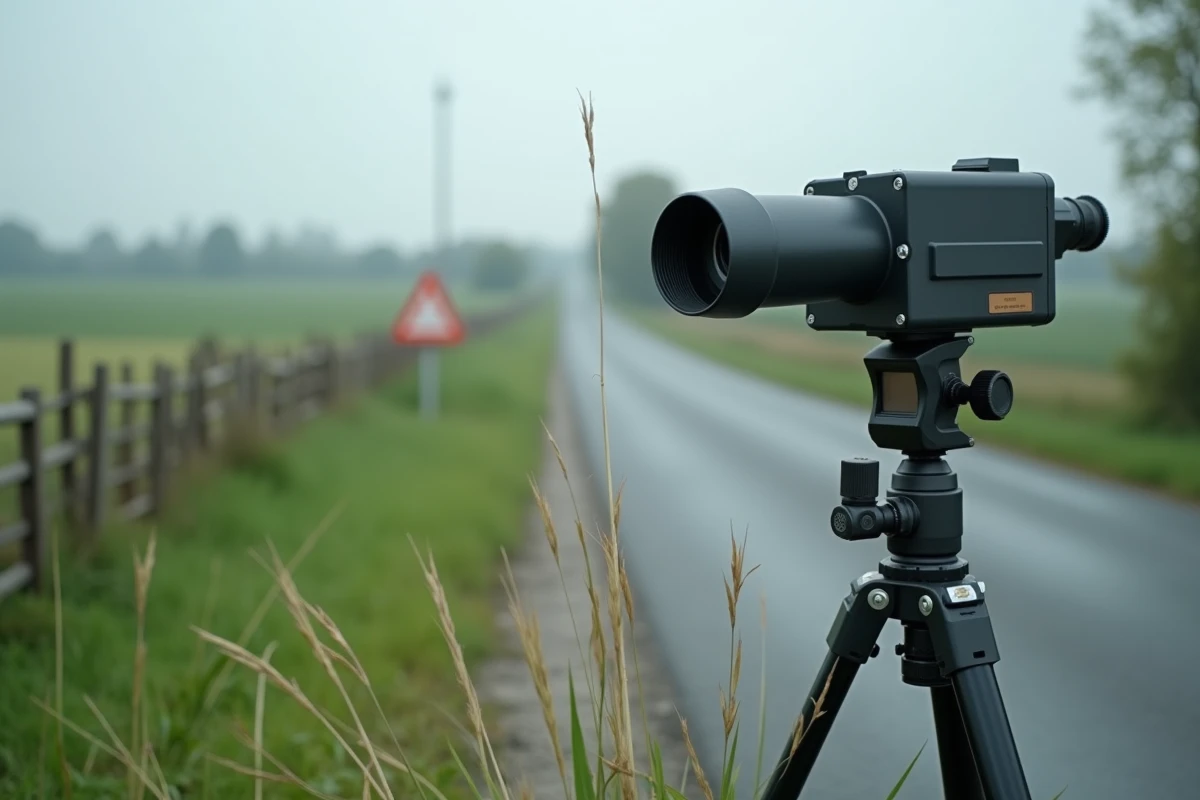
Do you see the problem? On a multi-lane road, or in heavy traffic, the visual identification of the license plate becomes fragile. The officer must prove that he had direct and unobstructed visibility of your plate at the precise moment of measurement.
Recent court decisions confirm this requirement. Judges increasingly demand that the officer detail in his report the visibility conditions, the measurement distance, and the absence of obstacles between him and the targeted vehicle. A terse report on these points considerably weakens the prosecution’s case.
Weather conditions and license plate reading errors
Fog, rain, low light: these factors degrade the reliability of reading a license plate from a distance. According to a survey by the National Union of Municipal Police Officers (SNPM) published in March 2026, officers themselves report a downward trend in twin checks without interception. The main reason: license plate reading errors in bad weather, which generate complaints and cancellations.
If your check took place in the rain or under overcast conditions, mention it in your request for exemption. Adverse weather conditions weaken the evidential value of the visual record.
Contradictory expertise: a strengthened right for significant excesses
For the most significant speeding violations, the situation has changed. Since a ruling by the Court of Cassation on January 10, 2026, twin tickets without interception no longer benefit from the presumption of absolute reliability. For any speed recorded at more than 50 km/h above the limit, a contradictory expertise is now systematically imposed in case of contestation.
This means you can request that an independent expert verify the conditions of the check: the state of the device, the measurement angle, distance, and visibility conditions. This expertise, previously optional and rarely granted, becomes a powerful lever for the most serious offenses.
What the expertise concretely verifies
- The compliance of the device’s calibration and the traceability of its metrological verification certificate
- The measurement angle between the twin radar and the vehicle, which directly influences the displayed speed (a too steep angle overestimates the speed)
- The environmental conditions at the time of the check (weather, traffic, number of lanes, presence of other vehicles in the line of sight)
This list constitutes the technical foundation of a serious contestation. A lawyer specialized in traffic law will know how to exploit each point to weaken the procedure.
Steps to contest a speeding violation with twin radar
The contestation follows a precise administrative path. You have 45 days from the receipt of the speeding ticket to act. Two options are available to you.

- Send a request for exemption to the Public Prosecutor’s Officer (OMP) by registered mail with acknowledgment of receipt, accompanied by the contestation form attached to the notice
- Deposit the amount of the fine (without paying it) to preserve your rights to contest in front of the police court
- Attach any supporting documents for your contestation: weather report for the day, photos of the control area, witness statement, copy of the ticket with the absence of calibration mention
Never pay the fine if you intend to contest. Payment constitutes an acknowledgment of the offense and makes any subsequent contestation impossible. The deposit, however, does not count as payment: it will be refunded if the procedure turns in your favor.
Point withdrawal and fine: what is at stake
A speeding violation recorded by twin radar incurs the same penalties as a check by automatic radar: fixed fine and point withdrawal from the driving license. The contestation suspends the point withdrawal until the final decision of the court.
The fact that the vehicle was not intercepted does not change the scale of penalties. However, the absence of interception deprives the administration of certain elements of evidence, which mechanically strengthens your chances in case of a poorly constructed case.
The multiplication of procedural flaws in twin tickets without interception shows that this procedure, quick for law enforcement, sometimes backfires against the prosecution. A check without stopping the driver relies on fewer direct pieces of evidence, and every weak link in the documentary chain becomes a lever for contestation. Checking the calibration, questioning visibility, requesting contradictory expertise: these three reflexes are often enough to tip the scales of a case.